

Why Zero-Click Searches Are Rising and How to Adapt Your Strategy
September 10, 2025 | Sebastian Glendale
Table of Contents
Zero-click searches are now ubiquitous, leaving most brands uncomfortable. With traditional search results taking the backseat, we’re seeing more impressions than clicks.
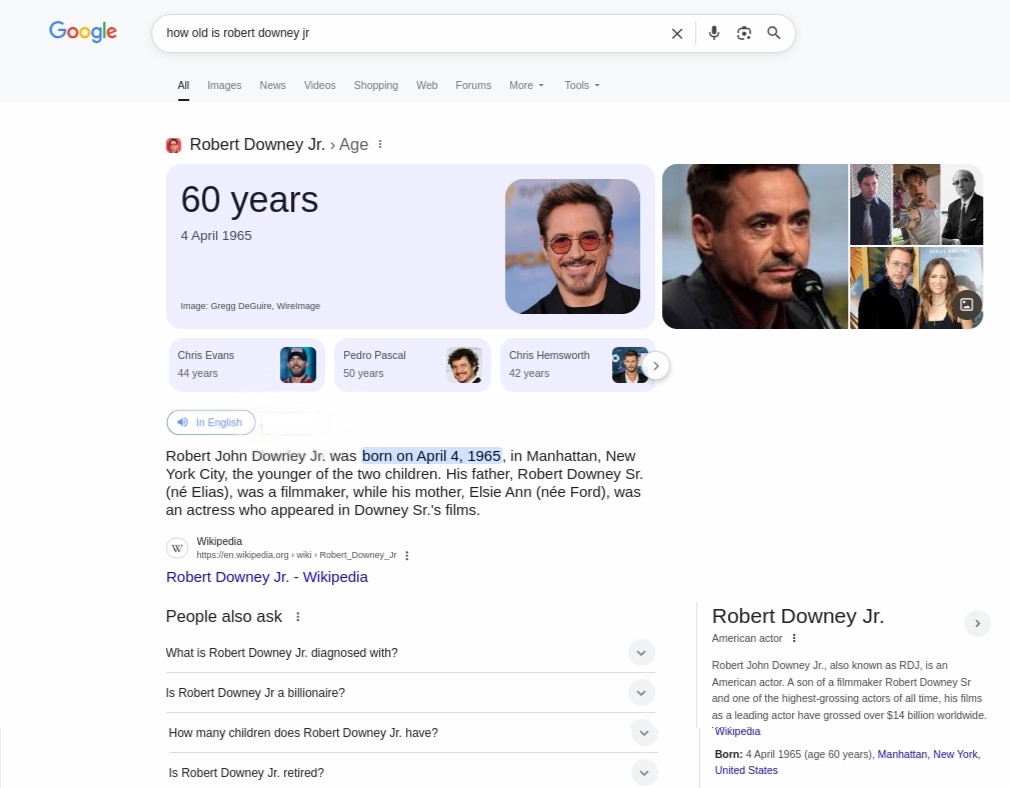
Fire up a Google search.
For example, “How old is Robert Downey Jr?”
Hit “Enter” and you’ll instantly get the answer right at the top. It also triggers a knowledge panel on the right and a People Also Ask section below. All this before one can scroll down to the actual search results. Hence the name, “zero-click searches”.
Now, is that a good thing for users?
Certainly, as it saves time pinpointing the actual answer without scrolling further. But for a brand, zero-click searches mean reduced web traffic, shifting target keywords, and even content cannibalization.
But here’s an interesting bit.
Industry studies have shown top organic search results receiving around 68% of total clicks (that’s two-thirds of all clicks).
Also, Semrush’s Zero-Clicks Study reveals more than 25% of desktop searches and 17% of mobile searches ending up in zero clicks!
In fact, when a zero-click search mentions a brand, it boosts your chances of appearing for normal SERPs (something that you might have to struggle for otherwise) and fires up additional enquiries later.
However, nothing’s certain. Even after you rank close to SERPs, there’s no guarantee of a rise in traffic.
At this point, the daunting question is, why are zero-click searches on the rise, and what can you possibly do about it as a brand?
As a leading digital marketing agency, we’ve successfully navigated through the digital waves for over two decades. And in this article, we’ll help you uncover the reasons behind the rise in zero-click searches, introduce you to different types of zero-click searches, and recommend powerful strategies to adapt. Keep reading!
Why Zero-Click Searches Are Rising?
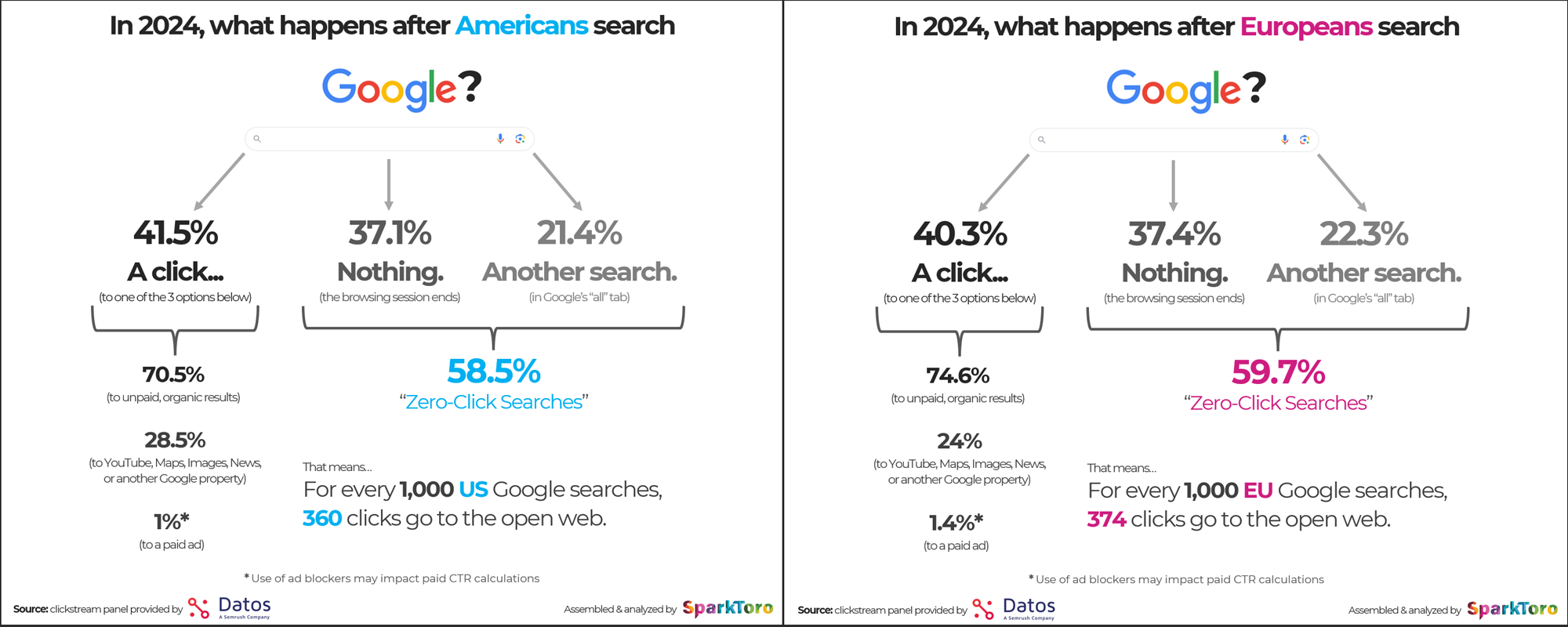
Last year, Dato’s clickstream funnel revealed a massive change in search behaviour for users across the U.S. and Europe.
SparkToro’s study shows that over 58% of Americans and almost 60% of European searches end up in zero clicks.
Top reasons behind the change in search behavior were featured snippets and AI overviews.
Also, not to forget Google deliberately routing the traffic more towards their own products, like Google flights and YouTube (the second largest search engine). But brands aren’t just losing clicks due to Google’s improved search features.
Today, consumers are increasingly searching and consuming content across other platforms. Take X and TikTok, for instance, where people come for both information and news. While looking for a product, a consumer is more likely to browse Amazon than Google’s traditional search.
Instagram and TikTok have already embraced zero-click strategies by restructuring clickability within posts. This increasingly growing trend also emphasizes the need for brands to keep users entertained and glued to one platform.
Lastly, we can’t ignore the impact of dark social, especially the traffic originating from messaging apps, stripping away the referral data. In doing so, they are obscuring the source and complicating the way we’ve been tracking and measuring our online marketing efforts.
So, by all means, zero-click search features are great for consumers, especially for discovering content. However, as a brand, you’ll need some solid strategies to counter these challenges and stay competitive. We’ll get to that in a bit, but first, let’s find out more about the different types of zero-click searches.
Know About The Different Types of Zero-Click Searches
Not all zero-click searches are the same, but they all have the same goal: to offer instant answers to user search queries.
Here’s a closer look at some of the most common types of zero-click search results and their features.
Featured Snippet
A featured snippet is a simple block of text that appears atop Google’s traditional search results. Usually, the information we see in a featured snippet is extracted from a particular website and has the page title and URL mentioned.
Featured snippets are pretty useful, especially when users are looking for immediate answers on complex topics and don’t have to go into detail (unless they want to).
AI Overview
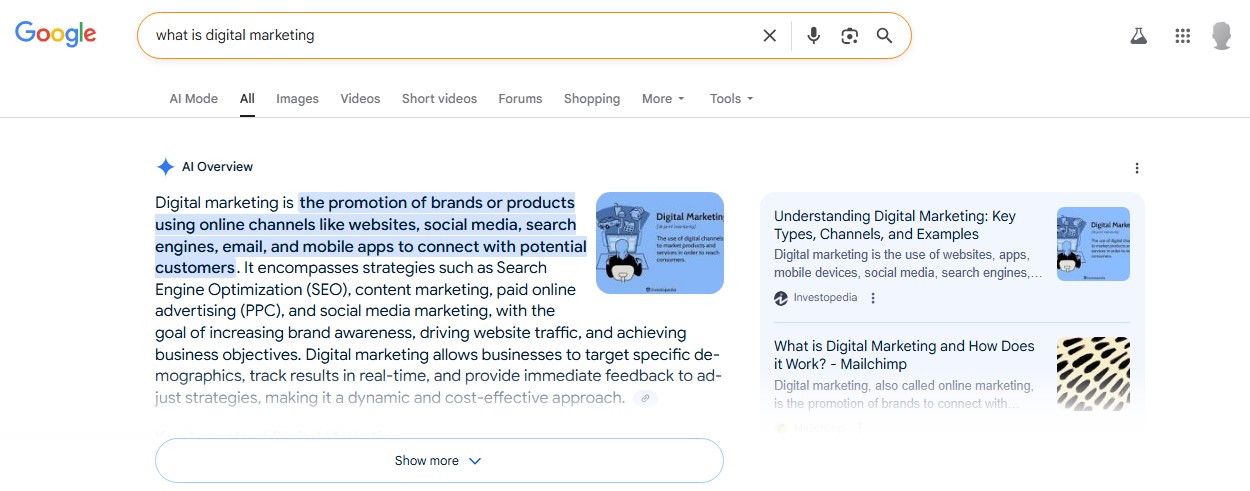
AI overview collates vital pointers on a particular topic from different sources and combines them together for easy reading and understanding.
Although every AI overview has options to check out the original text, it is purposefully designed to satisfy the user intent, i.e., finding answers without having to click the source links.
People Also Ask
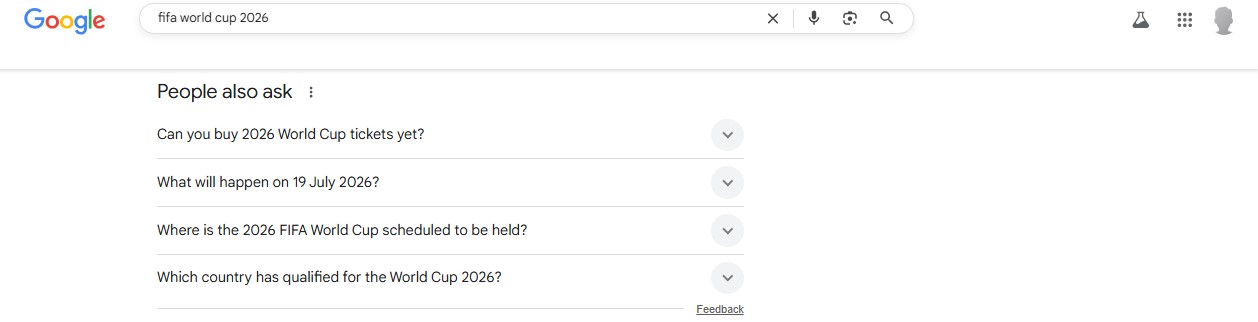
People Also Ask is a crucial Google SERP feature comprising several related questions for the original search query. Upon clicking a question, it shows a brief answer and a link to the source of information.
Any query that pulls up a People Also Ask (PAA) Box is indeed a zero-click search as it covers all vital info related to the topic.
Every time you click a People Also Ask question, Google auto-generates more questions and answers anticipating users’ needs. That’s why it’s always a good thing if your content appears in any one of the answers listed in the PAA box.
Knowledge Panels
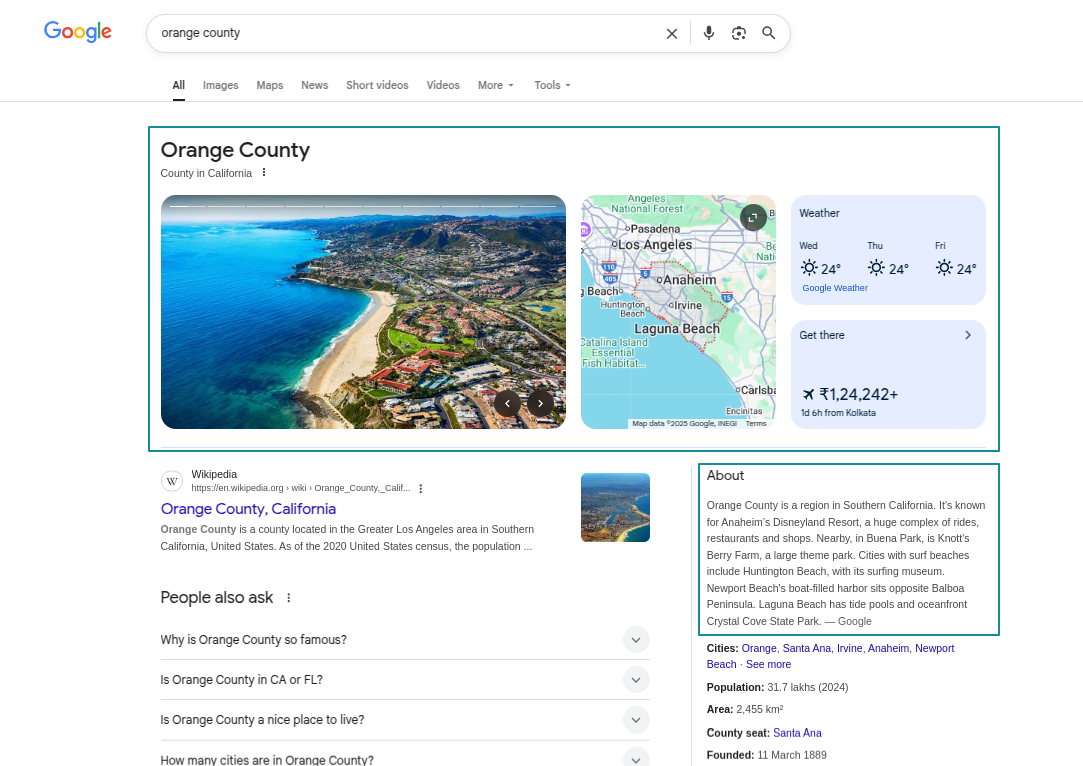
You might already be familiar with Knowledge Panels. They are the information boxes that automatically appear on the right side of every Google search and list a summary of crucial information about the topic.
The information included within a knowledge panel is based on Google’s own understanding of the subject and can include different formats like images, links, profiles, etc.
For businesses, it’s always great to have an exclusive knowledge panel designed that contains all details. That way, you can boost your brand visibility, increase awareness, and drive more organic traffic.
Now that you know about the different types of zero-click searches and what they are meant for, it’s time to build a strategy to survive in this zero-click era.
How To Create A Strategy For Zero-Click Searches
Contrary to what many businesses think, zero-click searches ain’t that bad for your business, especially from the SEO side.
The best part?
In some cases, the zero-click searches can work in your favor if you know how to optimize things.
Here’s how you build your SEO strategy to excel in a zero-click landscape.
Retarget Your Keywords
Start by focusing on those keywords that have a high chance of triggering a featured snippet or a People Also Ask box. (Leave out those keywords which are better suited for knowledge panels).
This is easy if you’ve already partnered with a reliable digital marketing agency with access to a premium keyword research tool.
It will help use advanced filters to selectively choose the SERP features to target for your list of keywords.
Creating Content With Direct Answers To Users’ Questions
No matter what content you create, it should address the search intent of users.
As a seasoned digital marketing company, we always focus on creating content that gives clear answers to genuine user queries.
Doing so helps our client website content show up in People Also Ask boxes and win featured snippets. In the long run, it also draws more organic traffic.
Follow the steps below to create content that offers a direct answer to users’ queries :
- Find as many related questions as you can get around your seed keyword.
- Use short, crisp, and clear headings for each direct answer to the related questions.
- If you feel the topic draws more than two to three questions, consider creating a FAQ section on your blog.
Prioritize Creating Content For Featured Snippets
When your content shows up as a featured snippet, half the battle is won. It puts you ahead in the competition, increases the chance of clicks, and establishes brand credibility in the eyes of Google.
So, here’s how to target your content to win a featured snippet.
- Always use a heading for any particular question that you’re answering with your content.
- Keep it concise and use a similar syntax to that of the currently featured snippet.
- Follow the elements that other types of snippets show for the particular search query. For example, if the current snippet shows a table, include a table in your article. If it shows a list, do the same.
- Don’t forget to track how many of your webpages currently rank for featured snippets and how many don’t.
Pay Attention to Schema Markup
A schema markup (also called structured data) is a simple code that can be added to your webpage to help search engines understand your content better.
It also boosts your ranking for matching search queries and improves the look and feel of your content across SERPs.
The image below shows a side-by-side comparison of a page with and without schema markup.
There are multiple schema markup types to go with, but make sure you choose the one that matches the content you’re posting.
After you choose your schema markup type, you need to run a test to see how it’s working. You can use Google’s Rich Results Test tool for that.
Improve Local SEO
Local SEO is another area that demands your focus for zero-click searches. Once you fix your local SEO, you can boost your chances of winning featured snippets and triggering knowledge panels as well. And the best way to go about it is to optimize your existing Google My Business Profile.
Make sure all relevant information fields are filled with the right data, like opening hours, location, contact number, and images.
Above all, your business name, address, and phone number should be the same across all online listings and directories to evaluate your brand reliability.
Ensure High Readability For Your Content
All content that appears in zero-click searches has one thing in common- high readability.
It means they are written in a very simple, lucid manner, with easy-to-understand words for both users and search engines alike.
And no matter how complex the topic is, any content you create for your brand should follow the same structure.
Here are some basic tips to follow so that your content has high credibility:
- Use short sentences and paragraphs when writing your content.
- Use subheadings to differentiate between sections
- Use bullet points and tables to convey relevant information
- Use images to illustrate your point
- Write in active voice
Time To Adapt For A Zero-Click Search Era
Undeniably, zero-click searches are here to stay, and the only way to survive is to optimize your SEO game. Forget basic plays; old SEO is dead.
Right now, it’s all about creating better content, offering direct answers to user queries, and chasing zero-click search positions like featured snippets and People Also Ask boxes for maximum impact.
However, things are easier said than done, especially if you’re a business with limited in-house resources.
That’s why we recommend teaming up with a reliable and functional digital marketing agency to make things happen.
If this sounds like something you want for your business, we can get you started right away!

RELATED POST

Table of Contents 1. Content Marketing That Tells a Story 2. Local SEO Domination 3. Visual Immersion with Virtual Tours 4. Mobile-First Optimization 5....
READ MORE
Whether you run a small or midsize business, you can no longer rely solely on sales generated from physical stores....
READ MORE
Nine years since the time Facebook made its presence and gradually shifted from being a toy in the dorm room...
READ MOREPartners



Copyright © 1999-2026, B3net inc.