

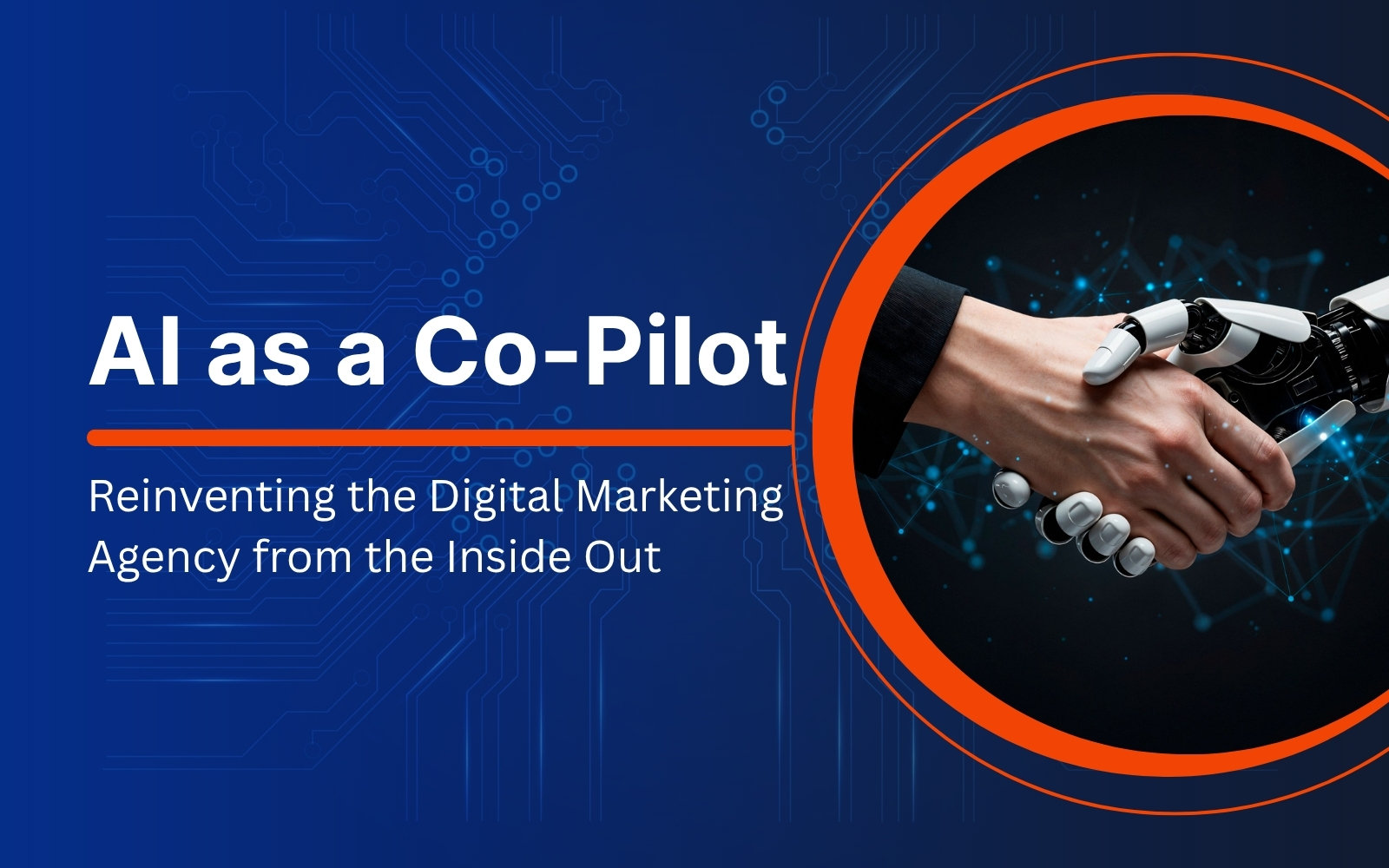
AI as a Co-Pilot — Reinventing the Digital Marketing Agency from the Inside Out
November 19, 2025 | Ashish Bhaumik
Artificial Intelligence isn’t just another shiny tool in the marketer’s toolbox. It’s a paradigm shift, reshaping the very foundations of how agencies plan, create, deliver, and measure digital experiences.
For pioneering digital marketing agencies, AI represents both an urgent challenge and a historic opportunity: to rethink the agency model from the ground up.
Clients now expect lightning-fast execution, hyper-personalized experiences, and measurable ROI like never before.
Creative cycles are shrinking. Data volumes are exploding. Competition is relentless.
In this new world, the agencies that integrate AI not only survive—they thrive, unlocking fresh value for clients and freeing human talent to focus on imagination and strategy.
This article explores a department-by-department blueprint for weaving AI into every aspect of a digital marketing agency, followed by a 90–120 day roadmap to make it real.
Think of it not as a technology overhaul but as a new way of working—where AI is the co-pilot, and human teams remain in command.
-
Why AI Is a Strategic Imperative for Agencies
AI has moved beyond being a “nice-to-have.” It is the new competitive differentiator. Agencies live and die by their ability to generate insights faster, personalize at scale, and deliver creative that cuts through the noise.
Traditional methods, no matter how polished, can’t keep pace with today’s demands.
Consider campaign optimization. What once required weeks of A/B testing can now happen in near-real time with AI-driven predictive analytics.
Audience segmentation, once a painstaking manual process, is now instantaneous. Even content ideation, which often hits bottlenecks, can flow faster with AI co-writing tools.
Agencies that resist adoption risk being outpaced by leaner, AI-empowered competitors. Meanwhile, those that embrace AI position themselves not just as service providers but as innovation partners.
Importantly, AI is not here to replace the human element—it amplifies it. Machines handle the heavy lifting of data and repetition, while humans bring originality, empathy, and cultural intelligence.
Together, they form a hybrid model that sets agencies apart in an increasingly automated marketplace.
-
Setting the AI Vision: The North Star for a Digitally Intelligent Agency
Before jumping into tools and pilots, agencies need clarity of vision. AI isn’t a plug-and-play fix — it’s a strategic evolution.
To achieve the real upgrade of becoming a truly digitally intelligent agency, leadership must define how AI will serve the organization as a whole and how each department will interpret that vision within its own workflows.
At the organizational level, the AI vision should answer three core questions:
- What do we want AI to enable that we can’t currently achieve?
- How will AI amplify our human talent rather than replace it?
- What ethical principles will guide our use of AI?
With that north star in place, each department then translates the vision into its own charter:
- Marketing & Strategy: AI as the lens that sharpens foresight — not just reacting to markets but predicting them.
- Creative Teams (Copy, Art, Design): AI as the spark for faster ideation and scaled production, while humans remain the arbiters of originality and emotion.
- Web & App Development: AI as a builder’s assistant — writing cleaner code, testing faster, and making digital experiences adaptive.
- CRM & Customer Experience: AI as the relationship enhancer, delivering hyper-personalization at scale without losing human touch.
- Human Resources: AI as the talent compass — guiding recruitment, engagement, and learning so the agency’s people grow alongside its AI capabilities.
- Finance & Accounting: AI as the financial guardian — ensuring accuracy, detecting risks, and forecasting with confidence.
- Operations & Project Management: AI as the orchestrator — balancing workloads, preventing bottlenecks, and aligning delivery with client expectations.
- Leadership & Business Development: AI as the growth amplifier — transforming raw data into strategic foresight and equipping leaders to act faster and smarter.
When each department has its own AI vision aligned to the agency’s larger mission, integration stops being about adopting tools.
It becomes about upgrading the agency’s intelligence itself.
Every workflow, campaign, and client engagement becomes part of a bigger trajectory: evolving into an AI-empowered, digitally intelligent agency that is always learning, adapting, and leading.
-
Department-by-Department AI Integration Blueprint
-
Marketing & Strategy
At the heart of every agency is the marketing brain—the place where insights fuel campaigns. AI supercharges this function with predictive analytics, real-time dashboards, and smart audience insights. Imagine knowing not just who your audience is, but what they’ll want next week.
AI-powered media optimization can dynamically shift ad budgets based on performance signals, eliminating wasted spend. Trend-spotting algorithms can surface emerging cultural moments before they peak, giving brands a first-mover advantage.
Result: strategy teams evolve from reactive planners into proactive growth architects.
-
Creative — Copywriting, Art & Design
Creativity is the soul of any agency, and AI doesn’t replace that—it accelerates it. Copywriters can use AI to generate multiple first drafts, explore alternate tones, or optimize for SEO, freeing them to focus on storytelling and brand voice.
Designers, meanwhile, can lean on generative AI tools to produce prototypes, mood boards, and concept sketches in hours instead of days. AI helps scale assets across platforms—resizing, formatting, and adapting visuals instantly.
The human touch remains critical. AI may generate a hundred variations of an ad, but only people can decide which resonates with cultural nuance and emotional truth. In this way, AI becomes a creative collaborator—sparking ideas, cutting production cycles, and leaving space for human originality to shine.
-
Web Development & HTML
AI has transformed development into a faster, more reliable process. Tools like GitHub Copilot suggest code snippets, detect bugs, and even automate documentation.
Testing frameworks powered by AI can identify vulnerabilities before they go live.
More importantly, AI enhances the end product. Websites can now be personalized in real time—content modules shifting dynamically based on user behavior.
AI-driven heatmaps predict where users will click, helping teams refine layouts without guesswork.
The result is not just faster development but smarter websites that evolve with their audiences.
-
App Development
Mobile and web apps are critical client touchpoints, and AI changes how agencies build and enrich them.
Development cycles shorten with automated code scaffolding and continuous testing.
Even more transformative: embedding AI features into apps themselves. Think voice-powered search, intelligent chatbots, or recommendation engines that adapt to user behavior.
These features don’t just delight users—they create stickier, more valuable apps for clients.
For agencies, this means shifting from building static apps to creating adaptive ecosystems that grow smarter with use.
-
CRM & Customer Experience
Customer relationships are the lifeblood of marketing, and AI brings superpowers here.
Predictive lead scoring identifies the prospects most likely to convert. AI-powered chatbots handle first-line support and qualify leads 24/7.
Most importantly, personalization finally delivers on its promise. AI can tailor email campaigns, push notifications, and website experiences to the individual—going far beyond “first-name personalization” into behavior-driven relevance.
For clients, that means higher conversions, lower churn, and more meaningful customer engagement.
-
Human Resources
Agencies often struggle to hire and retain top talent. AI helps by streamlining recruitment—scanning resumes, ranking candidates, and even detecting culture fit through behavioral analytics.
Once talent is onboarded, AI supports retention through engagement monitoring.
Subtle signs of burnout or disengagement can be flagged early. On the development side, adaptive learning platforms suggest personalized training paths, ensuring employees grow alongside the agency’s AI-first evolution.
-
Accounting & Finance
Numbers don’t lie, but they do take time. AI reduces the burden of manual bookkeeping by categorizing expenses and reconciling invoices automatically.
Predictive cash flow models help leadership anticipate gaps before they occur.
Fraud detection systems spot anomalies in financial data, reducing risk. By freeing finance teams from repetitive tasks, AI allows them to focus on strategic insights and advisory roles.
-
Operations & Project Management
Project management is where deadlines meet reality. AI brings clarity here by analyzing resource allocation, predicting risks, and even suggesting optimized schedules.
An AI-powered dashboard can forecast delays before they occur, giving managers time to intervene. Intelligent workload balancing helps teams stay productive without burning out.
The result: smoother projects, fewer surprises, and happier clients.
-
Leadership & Business Development
For agency leaders, AI acts as a decision-making accelerator. Market intelligence platforms aggregate competitor activity, cultural trends, and consumer signals into actionable insights.
AI also streamlines pricing strategies, helping agencies model different approaches and optimize profitability. Automated reporting means less time building decks and more time crafting vision.
In business development, AI-driven insights can pinpoint high-potential prospects, making pitches sharper and more relevant. Leaders gain not just efficiency but foresight.
-
-
The 90–120 Day AI Implementation Roadmap
-
Phase 1 (Days 1–30): Laying the Groundwork
Start with an AI audit—map workflows across departments and identify automation opportunities. Form a cross-functional AI task force of “early adopters.” Choose core AI tools for marketing, creative, dev, HR, and finance. Pilot AI in low-risk areas like copy ideation or invoice categorization.
-
Phase 2 (Days 31–60): Early Wins & Pilot Rollouts
Deploy AI for campaign optimization, chatbot pilots, HR screening, and automated coding. In finance, automate expense tracking. Track results weekly, capturing lessons to refine integration. Build confidence by showing tangible time savings and quality gains.
-
Phase 3 (Days 61–90): Departmental Scaling
Expand AI usage across workflows. Train staff on prompt engineering, bias awareness, and ethical oversight. Integrate cross-departmental AI pipelines—CRM insights feeding into marketing, finance data shaping resource planning. Document best practices into departmental AI playbooks.
-
Phase 4 (Days 91–120): Optimization & Institutionalization
Fine-tune AI models with agency-specific data. Establish governance around data privacy, compliance, and fairness. Roll out KPI dashboards to measure AI-driven improvements. Begin developing proprietary AI models or branded AI features to differentiate in the market.
By day 120, AI should be embedded into the agency’s DNA—supporting, not overshadowing, human talent.
-
-
Challenges, Ethics & Guardrails
AI is powerful but not infallible. Agencies must guard against over-reliance and bias in algorithms. Data privacy regulations demand careful compliance. Most importantly, AI must remain a tool, not a crutch.
Maintaining a human-in-the-loop approach ensures campaigns retain emotional intelligence and cultural resonance. Transparent communication with clients about AI usage builds trust. By approaching AI responsibly, agencies can harness its strengths without compromising ethics.
The Way Forward: Agencies as AI-First Partners
The truly “digitally intelligent agency” of tomorrow won’t just deliver campaigns—it will design ecosystems where AI and humans collaborate seamlessly. Creativity, strategy, and empathy will always remain human strengths. AI will handle the rest: the data, the scale, the repetition.
Agencies that embrace this co-pilot model today will become the architects of the industry’s future. The choice is clear: adapt and lead, or resist and risk irrelevance.
In the end, AI won’t replace agencies—it will redefine them. And those that harness it boldly will write the next chapter of digital marketing.

RELATED POST
Marketing is one of the most important tools to give a boost to your sales and help your business...
READ MORE
Thinking of entering into the ecommerce business? Then this is the right time! According to experts’ forecasts, ecommerce sales can...
READ MORE
Table of Contents Too SlowToo CongestedToo Many OptionsToo Many Pop-UpsBad Product PhotosBroken LinksWrong Call-To-Action ButtonNo SecurityAre your ardent efforts to...
READ MOREPartners



Copyright © 1999-2026, B3net inc.