Single-page websites, as the recent trends suggest, are one of the hottest and most popular things in the world of web design. And why shouldn’t they be? Standard single-page websites are easy to make, they have a crispy appearance, and are more appealing to website visitors.
However, single-page websites are not your perfect bets if you want to incorporate lots of content into your website. A single-page website often ends up looking cluttered with too many content forced into it. But getting your point across is necessary, and you have other options like animations, stock photos and relevant videos which can aid you effectively.
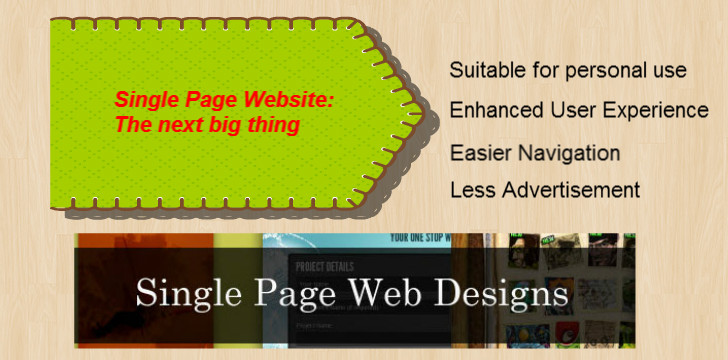
So what are the advantages of using a single-page website? Let’s have a brief look at the points below:
#1. Easier to organize content
#2. Enhanced user experience
#3. Cheaper & less bandwidth usage
#4. Less number of advertisements
#5. Easier navigation & easier to maintain
There is no doubt that single-page websites come with some exciting advantages. Like any other thing in this world, however, it also has its own set of disadvantages. So, when you are going to create a single-page website, here are some points you must also take into consideration:
#1. Challenging to keep the page from becoming too large in size
#2. It might take long to load if the website is too large
#3. Limitations in SEO efforts
Judging by both the pros and cons of single-page websites, it is a perhaps the best option for small businesses. Business directories can greatly help in their local SEO efforts, and they can afford to avoid giving too much attention in the traditional SEO techniques. Moreover, they need more and more customers coming into their website. As they usually do not have too much information to share, they can utilize the appeal and crispness of these one-page websites.
It is also pretty important for you to know the basics of a single-page website – in order to get the best out of the web designer. Things are quite easy, and here are some little details your website must adhere to:
#1. The Focus: Staying focused is important. You might think this is to be easy, but you can get swayed away even when you have so little to work with. Before the designer begins his work, ask him to show you how he is planning to set things up.
#2. Hierarchy: When you have everything at the same page, you need to make sure that individual content can be differentiated easily. You readers must, at any point, never get confused about what they are reading in your website. Every information should be placed in such a way that they are easy to find and easy to read.
#3. Navigation: As every content will be one a single page, it is important to make sure that all the navigation buttons are in a proper working order. A single glitch in one of these buttons means that a visitor has to scroll down to the desired section. Now it’ll be a big turnoff and in turn, a huge bounce rate.
Conclusion
The ball is on your court now! But whatever you choose to do, there is no denying the fact that single-page websites, if used correctly, can turn out to be the biggest crowd-puller for your business.