Small business owners rarely considered competing directly with big brands, as they lacked the resources and capital to scale sustainably. Even if a small business had excellent products or services, it did not have large sales teams, advanced customer-tracking systems, or expensive automation tools.
That was their biggest bottleneck in growing beyond a certain level. Thankfully, small businesses can now address all these problems by strategically using AI-powered CRMs that go beyond basic automation to actually predict customer needs, score leads, and draft personalized communications.
If you are curious about how a single AI-powered platform can fix multiple problems and help small businesses compete directly with big brands, this blog is worth reading in full.
Big Brands Always Had Better Systems. AI-Powered CRM Helps Small Businesses Close This Gap.
There is a misconception that big brands succeeded only because they spent heavily on marketing. While their marketing budgets are undeniably large, they succeeded because they operated through structured systems. Analyse their operations closely, and you would notice a clear pattern. Leads are tracked properly. Follow-ups are automated. Customer histories are organised. Communication is standardised across every department.
It naturally puts small businesses at a disadvantage. Inquiries would sit unanswered in WhatsApp chats. Sales conversations got buried in email threads. Follow-ups depended entirely on someone remembering to do them.
As lead volume grew, it created more inconsistency, not less. But today, small businesses can organise their operations far more effectively using AI-powered CRM tools. The right platform can reduce operational chaos and help a small business appear far more professional and capable than its team size would suggest.
With AI CRM, Small Businesses Respond Faster
Response speed matters far more than most small business owners realise. Customers today expect quick replies, immediate confirmations, and smooth communication experiences. When a business is slow to respond, the lead does not wait. It moves on.
This is exactly the problem a regenerative medicine clinic was dealing with when they approached us. Their inquiries were coming in from two directions simultaneously: phone calls during clinic hours and website contact form submissions that arrived by email. There was no system connecting the two. Phone inquiries were handled on the spot, but email inquiries were sitting in an inbox that the front desk team checked inconsistently. Leads were going cold. Follow-ups were either late or never sent at all. The team was stretched across too many tasks to catch everything.
We implemented GoHighLevel for the clinic and connected both their phone and website inquiry channels into one unified pipeline. Every incoming call was logged automatically. Every website form submission triggered an immediate acknowledgment to the patient and created a task for the team internally.
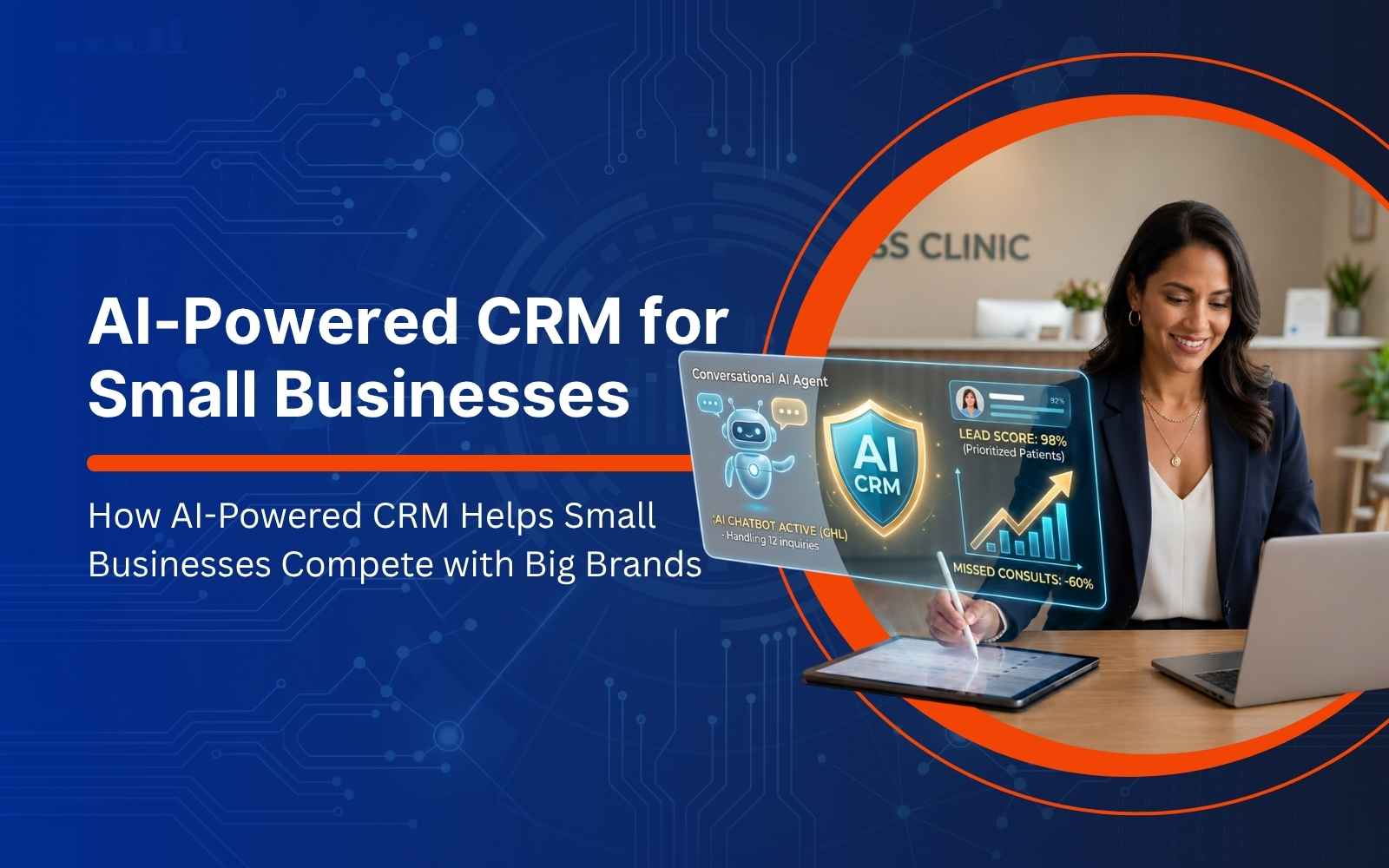
To take this a step further, we also set up a chat on their website, trained on the clinic’s treatment pages, and answered common patient questions. Patients could get answers and book consultations directly through the chat, even outside clinic hours. The front desk team came in each morning to confirm appointments rather than a backlog of unanswered messages.
We then built follow-up sequences that ran automatically based on where each patient was in the process, whether they had booked, were still considering, or had gone quiet after an initial inquiry.
The follow-up messages themselves were not generic either. The team wrote the templates once, and GoHighLevel handled the rest. Because the system tracked where each patient was in the process, it automatically sent the message that matched their situation. A patient who had just booked received a confirmation and preparation guide. One who had gone quiet for two weeks received a softer check-in. Same system, different conversation, no manual sorting required.
Because we utilized an AI-driven CRM, the system didn’t just log data. It actively analyzed it. Using AI predictive analytics, the system could automatically score leads based on their engagement, allowing the front desk to prioritize patients who were most likely to book a consultation.
Within the first two months, missed consultations dropped significantly. The team stopped chasing leads and started focusing on the patients already in front of them.
For a small business managing multiple inquiry channels, this kind of setup changes the entire rhythm of the working day. Less chasing, less forgetting, and far fewer opportunities falling through the cracks.
AI CRM Gives Small Businesses Enterprise-Level Customer Tracking Without the Enterprise Cost
Big brands have historically been better at customer tracking because they invested heavily in centralised databases and dedicated support infrastructure. Small businesses managed relationships through memory, spreadsheets, and disconnected tools. When customer volume increased even slightly, things would slip. Previous conversations were forgotten. Important follow-ups were missed. Over time, it created poor customer experiences that quietly eroded trust.
A medical equipment manufacturer we worked with was experiencing exactly this. Their sales team was coordinating distributor relationships, product inquiries, and follow-ups across individual email inboxes and a patchwork of spreadsheets. When a distributor called with a question, the sales rep had to dig through email history to piece together the conversation. There was no shared view of what had been discussed, what had been promised, or where each relationship stood.
We implemented Zoho CRM for their team and brought all of their customer data, interaction history, and sales activity into one place. Every distributor had a complete record that anyone on the team could access instantly.
Alongside the CRM, we implemented Zoho SalesIQ and set up a chatbot on their website. We trained it on their product catalogue and common distributor questions. It could handle incoming enquiries around the clock, answer product-specific questions, and pass qualified leads directly to the right sales rep with the conversation already attached. The sales team stopped being the first point of contact for every website visitor and started being the closer.
The shift in how their team engaged with distributors was immediate. Conversations started with context instead of confusion. No distributor had to repeat information they had already shared.
This kind of customer continuity is what large organisations have always had. AI CRM makes it accessible to businesses that are still growing into their systems.
AI CRM Helps Small Business Teams Operate Like Larger Organisations
In small businesses, one person or a very small team is often executing multiple responsibilities in a single day. Sales, customer support, operations, and follow-ups all land on the same two or three people. As the business grows, this creates steady operational pressure, and the likelihood of errors increases.
With AI CRM, much of the administrative burden can be handled without manual input. The medical equipment manufacturer is a good example of how this plays out in practice.
After the initial Zoho CRM and SalesIQ setup was stable, we went further. We built automation workflows so that routine coordination happened without anyone triggering it manually. When a deal moved to a new stage in the pipeline, the relevant team member was assigned a task automatically. When a meeting was logged, a follow-up reminder was scheduled without anyone having to set it.
We also built a custom dashboard for the sales manager, giving them a real-time view of the full pipeline. The dashboard showed where deals were sitting, which follow-ups were overdue, and which distributors had gone quiet and for how long.
Instead of spending half the day coordinating next steps and asking for status updates, the team could finally focus its energy on building relationships and closing deals.
This is what AI CRM enables for small businesses. Not replacing people, but making sure people are spending their time on work that actually moves the business forward.
Small Businesses Can Make Better Decisions with AI CRM
Large companies rely on data and analytics to make decisions. Small businesses have historically made decisions based on information scattered across spreadsheets, chat messages, and disconnected tools. That gap in visibility is one of the main reasons small businesses struggle to make decisions with the same confidence as larger competitors.
For the medical equipment manufacturer, better decision-making became one of the most valuable outcomes of the entire engagement.
Once the Zoho CRM was fully operational, Zia, Zoho’s built-in AI assistant, could analyze historical data patterns to predict which deals were most likely to close and suggest the best times to contact specific distributors based on their past behavior. The sales manager could identify which distributor segments were converting at the highest rate, where deals were consistently stalling, and which outreach efforts were generating real responses.
We also integrated Mailchimp into their Zoho CRM, so their email marketing activity and CRM data were connected. When a campaign went out, the team could see exactly which distributors engaged with it and follow up with the right message at the right time. It was a clear example of how Zoho CRM is built to work alongside the tools a business already uses, rather than asking them to replace everything at once.
Within a few months, the manufacturer reported meaningful growth in their distributor pipeline. Decisions that had previously required a quarterly review and a lot of guesswork were now being made with a clear and current picture of what was actually happening.
Strategic clarity is what separates businesses that grow steadily from those that stay reactive. AI CRM gives small businesses access to that clarity without requiring a dedicated analytics team to produce it.
Wrapping Up
As small businesses have gradually begun implementing AI CRM across their daily operations, they are benefiting from capabilities once available only to large enterprises. Faster response times, structured follow-ups, real-time customer tracking, workflow automation, and data-driven decision-making are no longer out of reach.
Whether you are running a clinic managing patient inquiries across phone and email, or a manufacturer coordinating a distributor network across regions, the right AI CRM setup changes how your business feels to the people you serve and how clearly you can see what is working.
It is something we see consistently in the work we do at B3NET. Businesses that invest in the right systems do not just operate better. They grow with far less friction.
You shouldn’t be losing good leads to bigger competitors simply because they have better software. Get in touch with B3NET today, and let’s map out an AI CRM strategy that actually fits the way your team works.