Social media is still one of the most powerful marketing channels available to you in 2026. No other platform lets you connect directly with your customers, build a loyal community, and grow your brand, all in one place.
And the numbers back it up. As per statistics
- People around the world spend an average of 141 minutes per day on social media
- Instagram holds the top spot as the most downloaded social media app globally
- Facebook has over 3.06 billion monthly active users
- Around 2 billion people actively use Instagram every month
Those are not small numbers. That is your audience, already on these platforms, already scrolling, already looking for something worth their attention.
But here is the thing. Social media in 2026 is not the same as it was even two years ago. Platforms keep evolving. Algorithms keep getting smarter. And audiences have become much more selective about what they actually stop to engage with.
Winning on social media does not require a bigger budget or a larger team. What it does require is choosing the right content formats and executing them consistently.
Whether you are a startup finding your footing or an established brand looking to sharpen your strategy, understanding which content formats drive engagement, trust, and conversions is where you need to start.
Key Elements of Social Media Content Creation
Before we get into the formats, let’s talk about what actually makes social media content work. Because posting regularly is not enough on its own. Great social media content is built on a few non-negotiables.
Know Your Audience Before You Post Anything
This sounds basic, but it is where a lot of brands go wrong. If you do not have a clear picture of who you are trying to reach, what they care about, what problems they are dealing with, and how they spend their time online, your content is essentially a guess.
Audience research does not have to be complicated. Start with your existing followers. Look at who engages most with your content and why. Build from there.
Every Piece of Content Should Have a Goal
Not every post needs to convert. But every post should have a clear purpose. Common content goals include:
- Increasing brand awareness
- Generating leads
- Building community and driving engagement
- Promoting products or services
- Establishing authority in your industry
When you know the goal before you create the content, everything- the format, the messaging, the call to action- falls into place more easily.
Offer Real Value in Every Post
People do not follow brands on social media to be sold to constantly. They follow brands that give them something useful, a tip they can use, a perspective they had not considered, information that makes their day a little easier.
Value can come through education, entertainment, inspiration, practical problem-solving, or even just a well-timed industry update. The format matters less than whether the content actually helps someone.
Visuals Do the Heavy Lifting
The first thing anyone notice is your visual. A strong image or video thumbnail determines whether someone stops scrolling or keeps moving. High-quality visuals are not optional; they are what get your content in front of more eyes.
Your Hook Decides Everything in the First Few Seconds
Whether it’s a video or a caption, the opening line needs to earn the next click or scroll. A strong hook creates curiosity, raises a question, or names a problem your audience already has. If you lose them in the first three seconds, the rest of your content does not matter.
Keep Reviewing What Works
Relevant content does not end at publishing. Your metrics will tell you what your audience actually responded to. Review them regularly, adjust your approach, and do more of what works. It is a cycle, not a checklist.
5 Content Formats Driving Results on Social Media in 2026
In 2026, the content formats that perform best share one trait: raw authenticity over polished production. Audiences can spot over-edited content instantly, and they scroll past it. What they slow down for is content that feels real and useful.
Here are the five formats that are consistently delivering results right now.
1. Short-Form Video: Educate, Entertain, Engage
Short-form video is dominating feeds right now, and it is not hard to see why. Viewers want quick solutions, practical tips, and useful insights that fit into a busy schedule.
Our collective behavior has fundamentally rewired over the last two decades. Landmark digital tracking research from the University of California, Irvine reveals that the average human attention span on a digital screen has plummeted from 2.5 minutes in 2004 to just 47 seconds today
A 30-to 60-second video that actually teaches something is far more valuable to your audience than a beautifully produced clip that says nothing.
Duolingo is the perfect example here, though with a twist worth noting.
Duolingo is a language-learning app. Education is literally their product. Yet on TikTok and Instagram, they rarely lead with lessons. Instead, they make short, chaotic, funny videos starring their green owl mascot, Duo, and sneak the educational angle in through humor and personality.
They have over 4.8 million followers on Instagram and 17 million followers on TikTok.
View this post on Instagram
Some formats that work well in this space:
- Industry tips and best practices
- Product demonstrations
- Quick tutorials
- Expert insights in 60 seconds or less
- Behind-the-scenes processes
The key is clarity. Clear messaging, concise delivery, and a hook strong enough to keep someone watching past the first three seconds. You do not need a production studio; you need a good idea and a phone with decent lighting.
2. Carousel Posts That Tell a Story
Carousel posts continue to be one of the highest-performing formats on Instagram and LinkedIn, and the reason is simple: they keep people swiping.
Instead of cramming everything into a single static image, carousels break your idea into digestible sections. Each slide earns the next swipe. The format works especially well for explaining concepts, walking audiences through a process, or building a narrative across slides.
Popular carousel topics include:
- Step-by-step guides
- Industry trend breakdowns
- Data-driven insights
- Case studies
- Product comparisons
- Myth versus fact content
A smart tip: many brands repurpose existing long-form content, blog posts, webinars, guides, into carousel format. It extends the life of content you have already created and gives it a new audience.
3. User-Generated Content and Customer Stories
On social media, trust has become one of the most valuable currencies you can earn. Consumers increasingly rely on real experiences and peer recommendations before they make a purchase decision. And that is exactly why User-Generated Content continues to outperform traditional brand messaging.
UGC is content created by your customers, clients, or community, not your marketing team. It is authentic because it is not written by someone trying to sell something.
For instance, when an everyday consumer gets a great product and shares their unedited, honest opinion over a quick TikTok or Instagram video, there is a massive chance it may go viral. That single organic moment carries more psychological weight than a million-dollar ad budget because it represents genuine proof of concept.
Take this Instagram post from @nabilahhmakeup, a creator based in Zagreb, Croatia. She is not a Nike employee. Nike did not script her caption or style her outfit. She simply wore her Air Max Viva sneakers, posted a natural photo, and tagged the product with #AirMaxMondays. That one organic post, created by a real person in her own voice, did more for Nike’s credibility than any polished ad could — because her followers trust her, not a brand account.
View this post on Instagram
Some examples of UGC content include:
- Product reviews
- Customer testimonials
- Unboxing videos
- Before and after results
- Social media mentions and tags
- Customer success stories
You can encourage UGC by running campaigns, requesting reviews after a purchase, featuring customer stories in your posts, or simply engaging actively with your community. The more you spotlight your customers, the more others want to be featured.
But remember the door swings both ways. When a brand relinquishes control of its narrative to the public, the exact same mechanics that make positive content go viral can amplify a negative experience overnight. Because of our inherent “negativity bias,” audiences actively hunt for the catch.
How to Defuse and Manage Negative UGC
Managing the dark side of UGC isn’t about erasing bad reviews; it’s about controlling your response. Here is the short, tactical playbook to handle it before it spirals:
Catch It Early: Monitor your brand tags daily. Catching a complaint at 100 views prevents it from hitting 1 million.
Never Delete: Unless it’s hate speech, deleting comments looks like a cover-up and triggers a worse public backlash.
Acknowledge Publicly, Fix Privately: Reply to the comment within hours so the audience sees you care, then move them to DMs immediately.
“We’re so sorry about this. We want to make it right—please check your DMs so we can resolve this for you today.”
Fix the Root Cause: Treat recurring negative videos as free product feedback. If multiple people complain about the same issue, fix the product, not the comments.
4. Thought Leadership and Expert Commentary
AI has made content creation easier than ever before. Which means the internet is now flooded with generic content that all says roughly the same thing. In that environment, original thinking and expert perspective become genuinely valuable.
Thought leadership is how brands stand out in crowded digital spaces in 2026. It is not about sharing what everyone already knows. It is about offering analysis, opinions, and observations that your audience cannot easily find elsewhere.
Let’s say that an AI writing tool drafts a 1,000-word article on “The Future of Remote Work” in five seconds. Because it is so effortless, 50 different tech companies publish virtually that same article on the exact same day. It becomes an invisible wall of digital noise.
Now, let’s look at how a true thought leader breaks through that wall. Instead of posting that automated text, the company’s CEO drops a quick, punchy video.
Jamie Dimon, CEO of JPMorgan Chase, is a textbook case. In early 2025, when practically every think-piece on remote work was saying the same diplomatic, hedge-everything thing, Dimon did something different. At an internal town hall in Ohio, he went completely unscripted. He went on a sharp, profanity-filled rant about remote work, bureaucracy, and inefficiency that was never meant to go public. Leaked audio of his remarks went viral almost immediately.
His blunt verdict? “You can’t learn working from your basement.” No caveats. No corporate softening. Just a direct, unpopular opinion delivered with full conviction.
The response was massive. The clip spread across LinkedIn, TikTok, and news outlets within hours. Dimon has continued to be particularly vocal, calling remote work a breeding ground for a certain kind of organizational dysfunction, a line that generated thousands of responses, arguments, and shares across platforms.
Did everyone agree with him?
Absolutely not. Gallup data shows that the modern workforce has heavily embraced flexibility, with 52% of remote-capable employees working hybrid and 26% working fully remote, leaving only about 1 in 5 working entirely on-site. But that is exactly the point. He did not go viral because he was right. He went viral because he was a real person with a real opinion, willing to say something that cut through the noise.
Well, we don’t particularly want to say you need to launch into a profanity-laced rant to get noticed, but ultimately, a quick, punchy video packed with real expert perspective is exactly how you shatter the invisible wall of generic AI noise.
Examples of leadership and expert commentary include:
- Industry predictions
- Expert commentary on emerging trends
- Lessons learned from real experience
- Founder and leadership perspectives
- Market analysis
- Professional insights specific to your space
This format performs especially well on LinkedIn, where audiences actively seek professional knowledge and industry expertise. People follow expert voices because they are looking for guidance they can trust. As information becomes more accessible, unique viewpoints become more valuable.
5. Interactive Content That Invites Participation
Social media platforms reward engagement, and interactive content creates direct opportunities for your audience to participate rather than just observe.
Instead of passively consuming your content, users become active contributors to the conversation. That shift matters both for your algorithm performance and for how your audience feels about your brand.
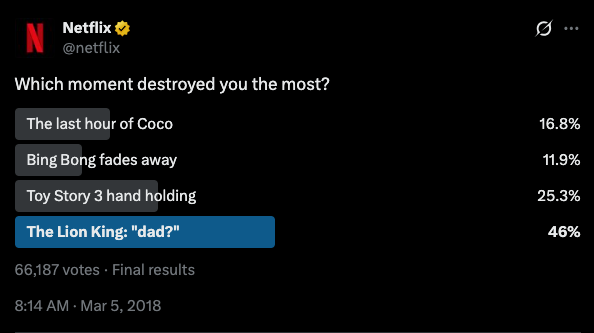
Netflix is one of the best examples of this done right, and at scale.
They regularly run simple polls on Instagram and Twitter: “this character or that one,” “which ending did you prefer?” One such poll alone pulled in 66,000 votes. No ad spend. No research budget. Just a single question that turned passive scrollers into active participants, and gave Netflix real audience data in return.
Interactive content can take many forms:
- Polls
- Quizzes
- Surveys
- Q&A sessions
- Interactive stories
- Community challenges
- Opinion-based discussion posts
These formats offer two important benefits. They increase engagement by encouraging direct participation. And they help you actually understand your audience, their concerns, preferences, and interests, without running a formal research study.
In 2026, community building is playing a major role in how brands grow their social presence, making interactive formats more important than ever.
How to Choose the Right Content Format for Your Brand
Not every format will work for every business, and that is fine. The goal is to align your content format with your specific goals and your audience’s preferences.
If you are trying to build credibility and attract a professional audience, thought leadership and educational short-form video will serve you well. If you want to drive social proof and purchase decisions, UGC and customer stories will do the heavy lifting. If you need engagement that feeds the algorithm, interactive content is your best lever.
The most successful brands do not rely on a single format. They combine multiple approaches and reach their audience at different stages of the customer journey while keeping their content fresh.
Start with one or two formats that fit your goals. Test them consistently. Review your metrics after a few weeks and see what your audience is actually responding to. Then build from there.
Final Thought
Social media platforms will keep evolving. Algorithms will keep changing. But one thing stays constant: content that genuinely helps, engages, and inspires people will always outperform content created just to fill a posting schedule.
So go back to the basics. Know your audience. Define your goals. Pick the formats that make sense for your brand, whether that is a punchy short-form video, a carousel that tells a story, or a poll that sparks a conversation. And then show up consistently with content that actually earns attention.
The five formats we covered in this article are not trends that will fade by next quarter. They are built on something that does not change: people respond to content that feels real, useful, and worth their time.
That is how you win on social media in 2026. And if you are looking for a team that lives and breathes digital and social media marketing, we are here to help you make it happen. Just reach out to us for a free consultation.