AI-generated content has become the default tool for most businesses. It is one of the fastest ways to produce a large volume of content without spending a lot of budget or time. Social captions, blog posts, even full website pages, everyone leans on AI for some part of the process now.
As a digital marketing agency, there is one question we hear constantly.
“Will AI content hurt my SEO rankings?”
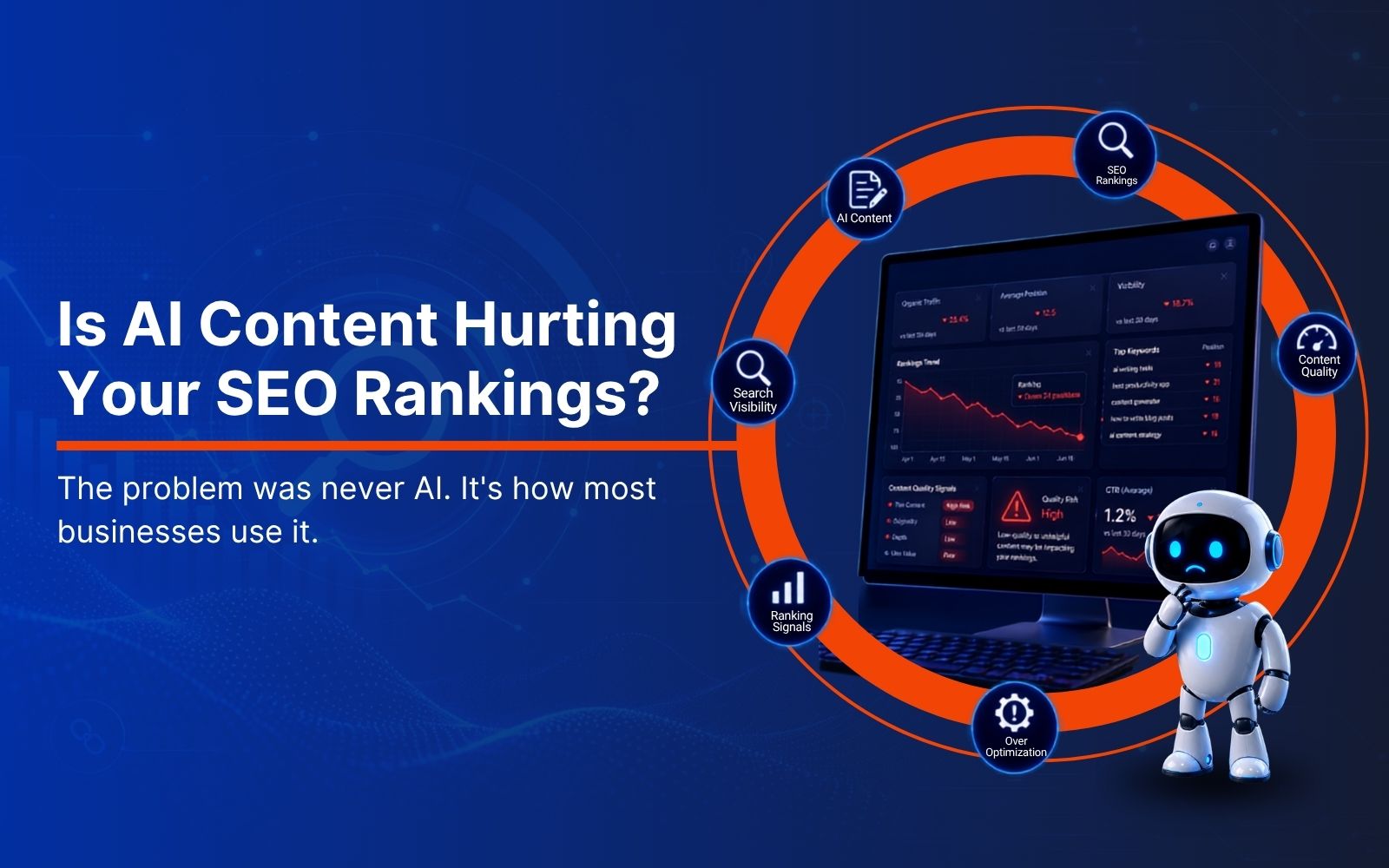
The short answer is no. AI content itself is not the problem. The problem is how businesses use it, and the data backs this up clearly.
Over the past couple of years, we have audited hundreds of websites across different industries, and one pattern keeps showing up. Websites that lean on AI to mass-produce low-quality content see declining engagement and weaker conversion rates. Businesses that pair AI with human expertise and real experience consistently outperform them in search results. One client we worked with cut their monthly output from twenty AI-drafted posts to six, each rewritten with a specific case study or client result folded in. Their organic traffic grew within the following quarter, not because they published less, but because what they published finally said something.
This is not just our observation. A widely cited industry experiment tracked what happens when AI content is published with zero human oversight, and the results explain exactly why our approach works.
What Actually Happens When You Publish AI Content With No Editing
A sixteen-month study by SE Ranking purchased twenty brand new domains with no backlinks, no authority, and no history, then published two thousand fully AI-generated articles across them with no human editing or enhancement at all. The pages got indexed quickly, and traffic rose early, but rankings fell hard afterward, with pages in Google’s top 100 dropping from 28% to just 3%. The researchers behind the same study also pointed out why. The content lacked the signals Google actually uses to judge quality and trust, including backlinks, credentialed authors, real-world expertise, unique insight, and clear site structure, and once those were missing, early visibility declined.
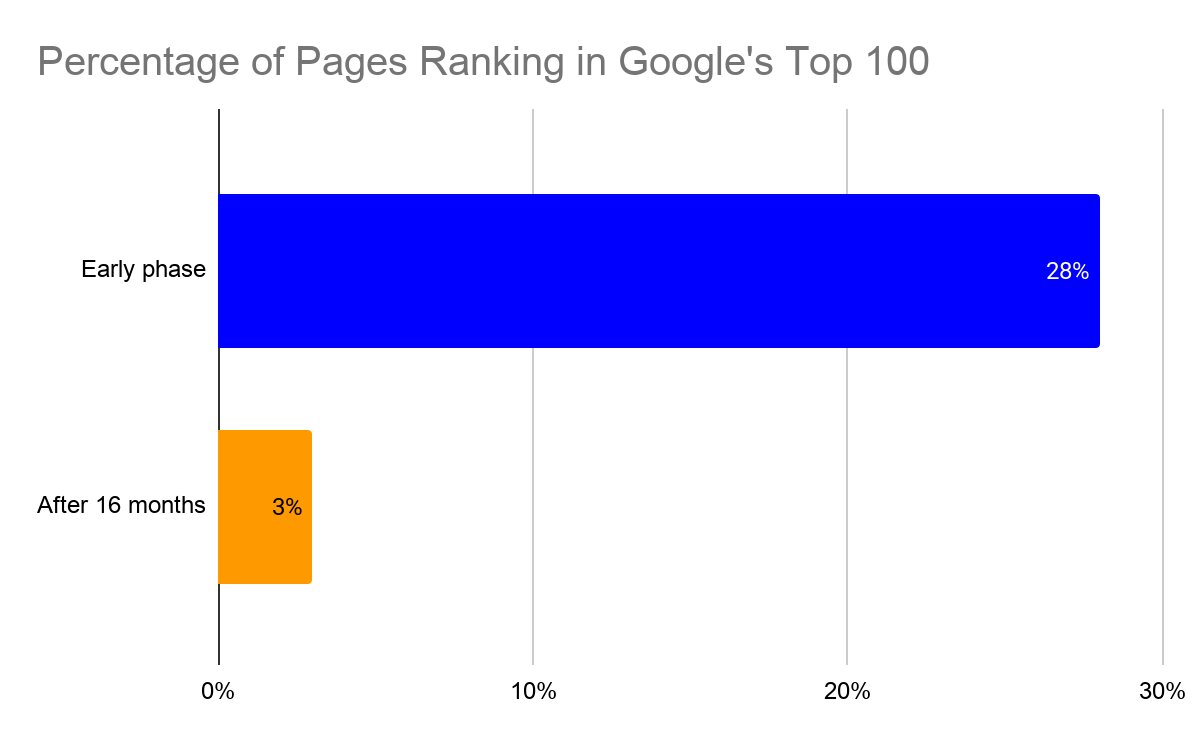
That is the pattern we described earlier from our own audits, now confirmed at a much larger scale. Indexing is easy. Staying ranked is the hard part, and it depends entirely on whether a page offers something a search engine and a reader cannot get from a dozen other pages saying the same thing.
Does Google Actually Penalize AI Content?
Not directly, and Google has been consistent about this. Google’s own guidance evaluates content quality rather than the tool used to create it, and other large-scale studies confirm that AI-assisted content shows up throughout top-ranking results. A separate analysis of twenty thousand blog pages found that AI content and human-written content had almost identical odds of reaching page one. 57% of the AI content analyzed reached the top 10, compared to 58% of human-written content, meaning both had nearly the same chance of ranking on page one.
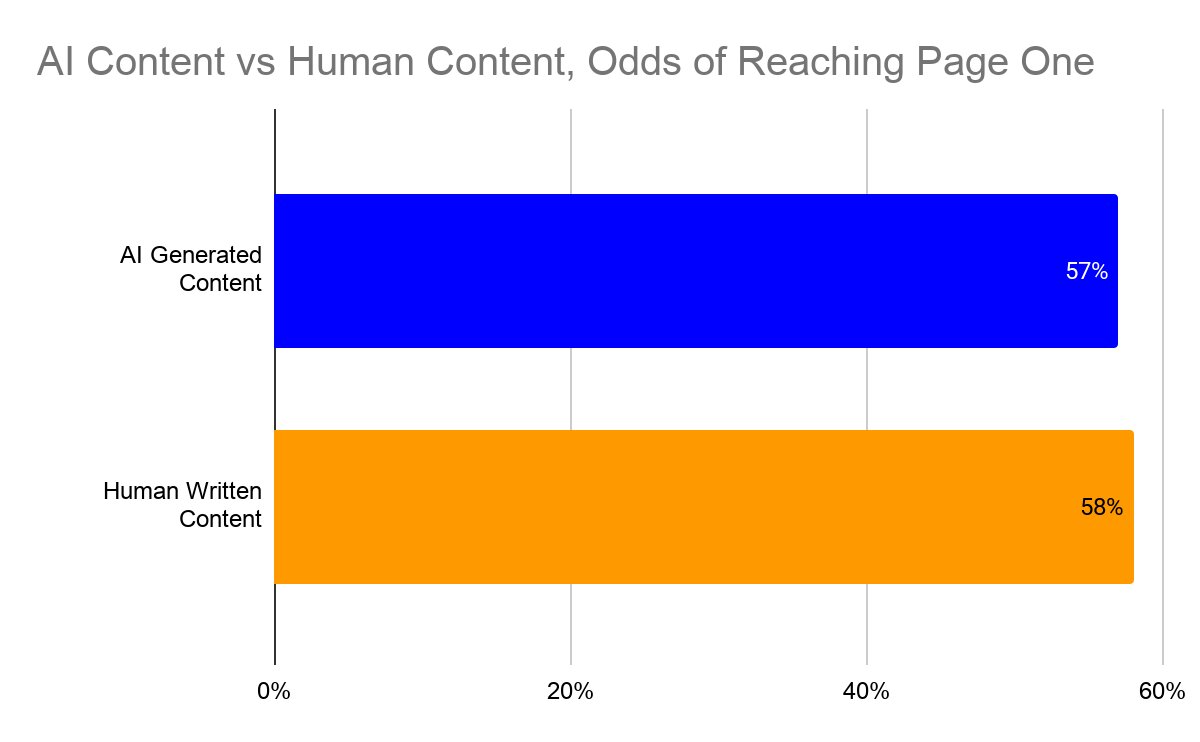
So the ceiling is not the problem. The gap shows up higher in the results. A separate large-scale ranking study found that 72% of SEOs believed AI content performed as well as or better than human content, yet the actual ranking data showed a clear human advantage at the very top of search results. In other words, AI content competes fine for page one in general, but the number one spot still leans heavily toward content shaped by a real person with real judgment.
The Importance of Experience in SEO Rankings
The biggest shift in SEO is Google’s growing emphasis on experience and expertise. Readers do not want surface-level information anymore. They want insight that comes from actually having done the thing.
When we write about SEO strategy, for example, we do not just define keywords and backlinks. We describe what has actually worked for our clients, including the approaches that failed first.
Google’s EEAT framework, which stands for Experience, Expertise, Authoritativeness, and Trustworthiness, plays a direct role in how content quality gets evaluated. Content that shows real-world experience and subject matter depth earns more trust, both from readers and from search engines.
Our own strongest performing blogs include examples, specific recommendations, and lessons learned from actual projects, not general advice that could apply to anyone.
Why Mass-Produced AI Content Often Fails to Rank
Quantity does not create authority. We regularly come across websites publishing dozens of AI-generated articles every month with no clear strategy behind any of them.
The result is a collection of content that targets the same keywords and repeats similar ideas in different words. This creates a set of predictable problems.
- Keyword cannibalization
- Low engagement metrics
- Thin content pages
- Reduced topical authority
- Poor user experience
Building authority gets harder, not easier, as a site fills up with generic pages. We have consistently found that a small number of genuinely strong articles outperform a large volume of forgettable ones, and the sixteen-month experiment above shows exactly what happens at the other extreme.
What Strong AI-Assisted Content Actually Looks Like
Use AI as a productivity tool, not as a replacement for your own thinking. It is excellent for research, outlining, and generating a first pass at structure. What comes after that first pass matters more than the draft itself. Every piece still needs a human review pass, where the actual thinking gets added in.
The strongest AI-assisted content tends to include the following.
Original insight. Readers are looking for a perspective they cannot find on the other ten pages that rank for the same keyword. That means industry observations, small case studies, or a specific recommendation drawn from actual work.
Genuine editing, not light proofreading. Strong content answers the question the reader actually typed in, rather than stuffing in keywords around a vague answer.
Information that has been checked, not assumed. AI models can generate information that is outdated or simply wrong. A regular review pass keeps facts accurate and current.
User Experience Matters More Than the Words on the Page
In 2026, SEO is about much more than just placing keywords. Google is reading signals that show whether a real person found the page useful.
- Time spent on the page
- Engagement with the content
- Relevance to the actual query
- Ease of navigation
- Overall page quality
If visitors land on a page and leave quickly, the content probably feels generic rather than relevant to what they were actually searching for. Over time, that pattern shows up in rankings, and it is increasingly showing up in AI-generated answers, too. Google’s AI Overviews reward pages that show clarity and topical relevance more than pure keyword placement, favoring content that clearly answers questions and explains processes in a structured way. This is the real reason content quality matters regardless of whether AI touched the draft. Every piece needs to actually help the person reading it, whether a human finds it through a blue link or an AI system pulls from it for a summary.
Where AI and SEO Are Headed
SEO has moved fast over the past few years, and AI is a large part of why. Keyword research, content drafting, and predictive analytics are all shaped by it now.
AI is not going anywhere in content marketing. Its role is only growing. But the sites that win will not be the ones publishing the most AI content. They will be the ones who pair the speed of AI with expertise that a machine cannot fake.
The brands that come out ahead are the ones using AI to move faster while still saying something only they could say.
AI is a Tool, not a stand-in for Expertise
The idea is simple. Use AI to suggest phrasing, structure, and a first draft. It cannot understand your specific business, your audience, or what actually happened on a project you ran last quarter.
That gap is exactly why AI content published without real revision reads as technically fine and convinces no one.
AI content is not inherently bad for SEO. Used at scale without oversight, it consistently leads to traffic loss, ranking drops, and a decline in how search engines assess a site overall, exactly as the sixteen-month experiment demonstrated.
Whether content comes from AI, a freelance writer, or an in-house team, the standard does not change. It has to provide real value.
From our experience, and the data now backs this up, the right approach treats AI as a resource, not a replacement for expertise. If a piece of content teaches the reader something, demonstrates real expertise, answers the actual question, and adds a perspective they could not get elsewhere, AI becomes a genuine asset to the strategy rather than a shortcut around it. That is exactly how we approach content for every client we work with.